Archive for the ‘News & Tips’ Category
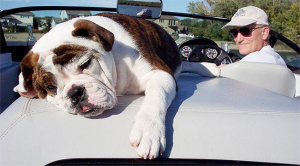
If a dog is man’s best friend, a disabled U.S. Air Force veteran showed the feeling is mutual by saving his drowning pet with mouth-to-snout resuscitation and CPR.
Lucy, a 10-month-old English bulldog, chased ducks into a partly frozen lake near Randy Gurchin’s home in Papillion, Nebraska, but quickly became paralyzed in the icy water and briefly went under. The 50-pound dog was unresponsive and had a blue face and bloody foam around its muzzle when Gurchin, who flew combat missions over Iraq and Afghanistan, edged onto the ice.
“The ice started to crack under me. I just picked her up,” he said. “I thought she was dead.” But Gurchin, 51, put his military first-aid training to use. He closed Lucy’s mouth, put his mouth over her nose and started forcing air into her lungs and pushing on her chest. Within minutes, the dog began breathing shallowly and was rushed to a nearby veterinarian. Doctors soaked Lucy in warm water, injected steroids and muscle relaxants and put her in an oxygen chamber. She has since made a full recovery.
“Our little Lucy is back,” said Gurchin’s wife Kelley. Her husband, who retired from the military with a back injury in 2005 and walks with a cane, has vowed not to let the dog out of his sight, she said. “He would never say he loved her until this rescue mission,” she said.
Source: Reuters
Well here in Denver we haven’t had snow in over a week, and that hasn’t happened in months, and Daylight Savings Time starts this weekend, so Spring must be upon us. Which means it’s time to take precautions to protect yours and other neighborhood pets and animals from the dangers lurking in your innocent looking garden.
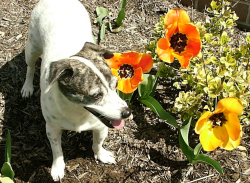 Animals that chew can get hold of poisonous seeds, leaves or berries. Dogs or cats that frolic or roll on the lawn can pick up toxic chemicals through their paw pads and skin and track them into the house. They can get scratched by thorns, stung by bees, bitten by fleas, landed on by ticks. People who love pets and gardening can have both, though, with a little common sense and careful use of pet-safe plants and chemicals.
The first good-sense rule is not to plant anything that’s toxic to animals. Toxicity can relate to the size of the animal and, of course, amount of material ingested, but it’s better to avoid anything that can be harmful. A sampling of landscape plants that are toxic include yew, wild black cherry, azalea, rhododendron, hydrangea, daphne, nandina, oleander, English ivy, daffodil, tulip, lily of the valley, foxglove, hyacinth, rhubarb and castor bean. Some toxic houseplants to avoid are dracaena, dieffenbachia, golden pothos, philodendron and peace lily. Cocoa bean mulch, a byproduct of chocolate manufacturing, contains both caffeine and theobromine, which are harmful to dogs.
If you already have some of these trees, shrubs or plants, you can minimize exposure by fencing them off, or by teaching the pet to avoid parts of the yard.
For lists of toxic plants, see www.cybercanine.com/toxicplants.htm or www.aspca.org. (Click on the link to Animal Poison Control and then click toxic plants.)
The next issue to consider is chemicals. The ingredients in herbicides, insecticides and soil amendments can be toxic. If they are, the package directions should say so. Some products are labeled as pet-safe; they may be based on ingredients such as corn gluten or seaweed.
You might think that the best course is to go organic, but not all organics are a good idea. For instance, one organic method to add phosphorus to soil is as pulverized bone meal. Dogs love bones, so they will lick this material. Generally, they won’t lick enough to hurt themselves, but if they get into the bags, they will wolf down enough to be dangerous. Products may not list some trace materials, such as heavy metals that may be present in the plant and animal byproducts and volcanic ash, ingredients in such all-natural fertilizers.
One common household product that makes a good organic fertilizer is used coffee grounds. But this is not good for your pet. For more possible problems, see the American Veterinary Medical Association’s website.
To keep pests in check, use integrated pest-management techniques, including improving soil and drainage conditions, using beneficial insects to fight harmful ones, applying the least toxic remedies for pests and diseases, and pulling or hoeing weeds.
If a potentially more harmful substance is required for the health of your garden, keep pets (and children) away from areas being treated. One source, “The First Aid Companion for Cats and Dogs,” suggests keeping pets off sprayed surfaces for a week.
And, speaking of things to avoid, if winter lingers be sure and watch out for hazards such as street salt spread on drives or walks; wipe pets’ paws before they come inside. And remember, antifreeze is also hazardous any time of year.
Happy Spring!
We saw the most amazing story of a Siberian Husky’s medical miracle on the local news. It was about a dog named Triumph who survived having her two back legs amputated, who came to Denver to get a chance at a normal life with prosthetic legs!
 Triumph’s story began in Turkey where she was found beside the road bleeding–her rear legs had been cut off. She was taken to a shelter where the first of many miracles began – they treated her wounds and kept her alive instead of having her euthanized as most would have. Her story was put in the paper there and for the next two months they tried to find her a home. Unfortunately, no one came forward; but two volunteers who worked with the shelter took a liking to her and began the huge effort of trying to find someone who was willing. They contacted a friend in Philadelphia who put the story up on the Siberian Husky rescue sites with a picture of the dog standing on a stainless steel table with a look that was hard to ignore. It was sent via email to a woman in Nashville who has worked for years with the most severely abused dogs, damaged either physically or emotionally. Marion Moeller, “Moe” as her friends call her, said when she first read the story and saw that the injured dog was in Turkey, she deleted the story thinking there was nothing she could do. Then later that same day, another person sent the same photo with the same plea, “can you please help this animal”. To Moe this was a sign she was supposed to do something and so she began getting more information. Ultimately Moe after 6 weeks of effort, was able to get a plane reservation for the dog, but it took a lot of money and a lot of convincing to get an international airline to agree to transport Triumph in her condition. Most of the $2100 was paid out of Moe’s own pocket.
Moe knew of a man in another town who made prosthesis for humans. When called, Tom came forward and volunteered to give making some prosthetic legs a try. After several trys Tom fashioned some prosthesis that had Triumph up and walking. Her story doesn’t end there however, ultimately (and after several more miracles you can read about in detail in Triumph’s story in her own words) she came here to Denver and met with Carrie at Colorado Rehab and Alameda East who introduced them to Dr. Robert Taylor who was able to offer a brand new cutting edge surgery that hadn’t been done before.
 Eighteen months and seven surgeries later, “She’s runnin’ with the big dogs now,” said Moe.

It took months for the skin and the bone to grow into the special foam metal. Triumph fought infection, and had to have one of the prostheses replaced. Now her doctor in Denver and her owner from Nashville hope the patient can finally be a pup again.
“The reason that we did this is so that she could lead a normal life,” said veterinarian Robert Taylor. X-rays show the newest implant in the right leg looks good, but Moe had concerns about the left because Triumph was licking it constantly. Blood tests showed bacteria causing a relatively minor skin infection, something her doctor said should be easily taken care of with an antibiotic. Dr. Taylor is pleased and Moe is ecstatic that Triumph, finally can go be a dog. And apparently it’s tough to keep up when Triumph takes off. The hope is she’ll come back to Denver from time to time, back to where the beautiful husky made medical history.
Please click the image below to view the news story, you will be astonished and moved.

You can read the complete news story on CBS4Denver.com, and visit Triumph’s own site, TriumphTheDog.net to read her history and get updates. Also, this week Triumph is being featured on an episode of Animal Planet’s “E-Vet Interns,” so you can set your Tivo and see more of Triumph’s amazing Triumph!
Another story of an amazing animal responsible for coming to the rescue of it’s people happened earlier this week in Oregon. Thanks to a high-tech electronic gadget and a big warm dog named Velvet, three climbers rescued after a harrowing fall and a night in the wind and cold high on Mount Hood are expected to be fine.
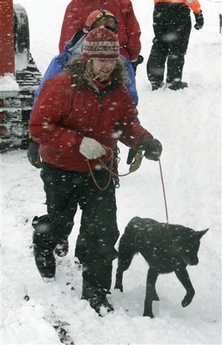 They were found at about the 7,400-foot level on Monday and hiked down the mountain with their rescuers.
Searchers credited the group’s rescue to two things — Velvet, a black Labrador mix who provided warmth as the three climbers huddled under sleeping bags and a tarp, and the activation of an emergency radio beacon the size of a sunglasses case that guided rescuers to the group.
Velvet, owned by climber, Matty Bryant, had minor cuts and abrasions on her back paws and legs from prolonged exposure to the snow, but she was cleared to go home.
“The dog probably saved their lives” by lying across them during the cold night, said Erik Brom, a member of the Portland Mountain Rescue team.
Fortunately the group was well-equipped for climbing Mount Hood in the winter with cell phones, global positioning system gear and the locater beacons. Still without Velvet they would not have had such a happy ending.
Pet-proofing your home begins when you decide which parts of the house you want to share with your four-legged friends. According to Dawn Hanna of Oh Behave, Professional Dog Training. “Unsupervised freedom is not a given,” she said. “It should be earned. Use a crate or a child gate to confine your pets to certain areas. Keep doors closed to keep Fido or Fluffy out of rooms that are off limits. But be careful of doors that close themselves.”
Here are other tips Hanna and other experts provided to protect your home from a destructive pet to make your life and theirs easier.
Look At Life From Their Point Of View
“It may sound crazy,” Hannah said, “but get down on the floor and look at your house from a pet’s eye view.
Pets love to steal things that don’t belong to them. So, clean up after yourself and remove the temptation. Pick things up off the floor and tables. Do not leave food, cans, candy, empty containers or plastic bags unattended. Even something as benign as a sock can be hazardous if your pet were to swallow it.
Cleaners, bleaches, fertilizers and antifreeze should be kept out of reach and behind closed doors. And since most of these items are found in your garage, that should be one room that’s completely off limits to your pets.
Off-Limits
Trash containers are irresistible to pets, and they often contain dangerous goodies like rubber bands, Q-tips, needles, thread and staples — goodies that may require surgery to remove.
Bathrooms offer an often overlooked hazard. “I used to think those greeting cards and photos showing a dog drinking from the toilet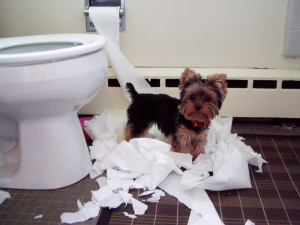 bowl were hilarious,” Hannah said. But she wasn’t laughing the day she had to rescue her dog from the bathroom toilet.
Also remember that whatever you use to clean your toilet could poison your pets. So, keep the toilet lid down at all times.
“Keep medicines and vitamins out of reach,” said Dr. Amy Balko of Faithful Companions Animal Clinic in South Florida. . “Hide electrical cords or anything that could strangle your pet. And never leave a candle unattended.”
If you love plants, remember that some are poisonous to pets. To learn more about poisonous plants and the symptoms to look for, visit The Animal Poison Control Center. If you have vines or hanging plants, keep them out of your pet’s reach. A curious animal can jump up and bring down whatever it grabs.
Remember to close off any balconies or windows from which your pet could jump.
Toss Those Old Toys
Pets love their toys, but you’d never know it the way they bite, cut and mangle them. Inspect your pet’s toys and throw out anything that’s old, tattered or that can hurt your pet if swallowed. You should also teach your children to keep their toys away from pets and put toys away so pets can’t get to them.
“Pet-proofing your home sounds a lot like the advice you’d get if you had a small child,” Dr. Balko said. But you have to be even more vigilant. A toddler may not be able to jump on your kitchen counter and grab those cookies you left out,” she said. “But it’s a skill any cat can master. The phrase “curiosity killed the cat” is not just a cliché.”
Source: WTAE-TV
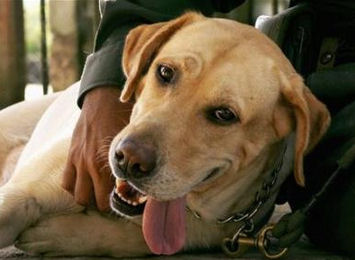 She’s had a price on her head since 2004 and a 24-hour guard monitors her food for poisoning. For a 5-year-old, she has made a lot of enemies. But none of this keeps Agata, a golden Labrador who is one Colombia’s best drug-sniffing dogs, from doing her job.
Stationed in the southern Amazon River border town of Leticia, Agata works at the local airport. She is the only Colombian police dog to have a contract put out on her by drug smugglers tired of having their goods confiscated.
More than two years ago, police intercepted a message from drug traffickers revealing a plan to poison her. “We take special care with her food,” said Robert Olanda, one of the officers who guards her.
Police say a $10,000 bounty was put on Agata’s furry head after a string of detections she made in 2004 in Colombia, the world’s biggest cocaine producer. She is one of nearly 700 dogs employed by Colombian national police to detect cocaine, heroine and explosives used by a mosaic of armed groups involved in Colombia’s 4-decade-old guerrilla war, in which thousands are killed every year.
Trained from puppies, the police dogs form a key part of Colombia’s U.S.-backed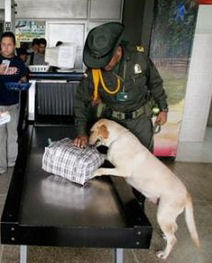 counter-narcotics program. Leticia is popular among drug smugglers trafficking to neighboring Brazil and Peru and also north toward the United States, the biggest consumer of Colombian cocaine. But first they have to get past Agata.
The 80-pound (36 kg) retriever, who energetically investigates about five cargo planes and one passenger flight every day, has helped authorities confiscate 300 kilos of cocaine and 20 kilos of heroin since she started working in 2003. “This dog has been decorated because she has been one of the most productive in the fight against drugs,” said Col. Carlos Medina, police commander for the Amazon region.
As drug-sniffing dogs serve up to seven years in the field, her keepers have already started thinking about retirement. “I am waiting for the day that happens so that I can take her to my house and let her rest, which is what she deserves,” said police dog trainer Oscar Eduardo Chuna.
Source: Reuters
A black Labrador Retriever in Ohio is expected to fully recover following surgery to escape a sticky situation, swallowing a quarter of a bottle of Gorilla Glue.
The dog named Reggie swallowed the glue two weeks ago, said Dr. Mark Reineck, a veterinarian at Fremont Animal Hospital. The heavy-duty polyurethane adhesive can be used to bond wood, stone, metal and brick.
Reineck played phone tag for a while with the dog’s owners, who had called when the dog first vomited, before being able to tell them to bring it in for treatment. The owners declined to be identified.
X-rays showed two large masses in the dog’s abdomen. Reineck said the glue turned into foam in its stomach that expanded when it mixed with food and fluid, then hardened.
Reineck operated on Friday and removed two stiff globs, one the size of an orange and the other as big as a head of cauliflower.
“The dog is now doing great and we expect a full recovery,” Reineck said. “But it was just too bad that he had to go through this major operation.”
Reineck — who has had to remove a raincoat, a stuffed animal’s head and the bottom third of a Christmas tree with glass ornaments from other dogs — said people need to be aware that household items can be attractive but dangerous for both pets and children.
Source: Yahoo News
Did you know that a lost dog is far more likely to be found than a missing cat? Why? Because man’s best friend is more likely to have identification tags and dog owners are more prompt in searching for their missing pets, according to a new study.
The findings, published in the Jan. 15 issue of the Journal of the American Veterinary Medical Association, found that while 71 percent of lost dogs in the Dayton, Ohio, area were reunited with their owners, only 53 percent of lost cats ended up back at home.
“Dogs seem to be easier to get home to their owners,†study author Linda Lord of Ohio State University told LiveScience.
Dogs vs. cats
In her survey of people who ran lost pet ads in local newspapers, Lord found that dog owners contact and visit shelters much sooner than cat owners after the pet goes missing. More than one-third of the recovered dogs were found after a call or visit to a local animal shelter.
Dogs are also more likely to sport tags or carry an ID chip implant, Lord said. Cat owners may not put identification on their cats because the cat shirks the collar or they keep the cat indoors. “Just because you keep your cat indoors doesn’t mean you don’t have to identify them,†Lord said. Cats still can slip out of the house. When people find cats without identification, they might assume they are strays and feed and adopt them, whereas people who see a dog wandering alone are more likely to assume it has an owner, Lord said.
Many cat owners also wait several days before calling or visiting shelters. They run the chance of missing their cat, which could be euthanized or adopted by someone else.
Of the study cats that did make it back to their owners, Lord said, two-thirds came back on their own.
Pet-finding tips
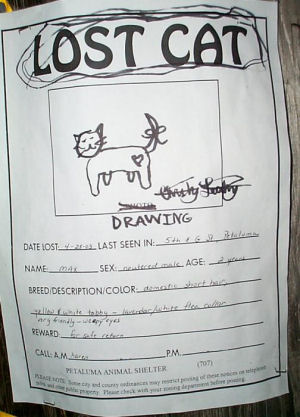 The key to finding a lost pet is visible identification, Lord said. If someone finds your pet, they can call the number on the ID tag without having to involve the shelter system. While microchips are a great backup, they are not visible to the naked eye and require shelters or veterinarians to scan them, she said.
Lord also emphasized that it is important to act quickly when looking for a missing pet by calling local shelters after one day, visiting every three days, putting up posters and even taking out newspaper ads.
The pet owners Lord interviewed were often surprised to hear about methods they hadn’t tried. “There was definitely a lack of awareness,†she said. Though different methods may be more or less effective in different places, Lord said, “people really need to think about having a plan.â€
Source: LiveScience
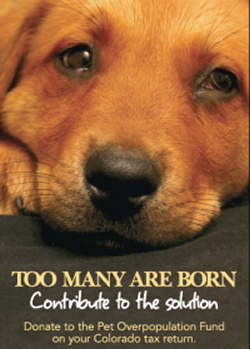 Here in Colorado every year on our state tax form we have the option of checking a box to contribute to the Pet Overpopulation Fund. We had occasion to talk with some of their representatives recently at a Healthy Pet Expo here in Denver and were very impressed with the program’s mission and success rates.
In the four years since its inception the Pet Overpopulation Fund has subsidized more than 21,000 spay and neuter surgeries for dogs and cats in Colorado. Donations from taxpayers help fund grants to local coalitions of veterinarians, animal care and control agencies, and community groups to perform spay and neuter procedures.. They also help create and implement education programs that encourage Colorado residents to have their pets spayed and/or neutered. All donations are used to benefit the animals; administrative services are provided at no cost to the Fund.
In addition to the small donation you can make on line 38 of your Colorado state tax form you can make contributions directly by check payable to the “Pet Overpopulation Fund”:
Colorado Pet Overpopulation Fund
455 Sherman St, Ste 462
Denver, CO 80203
We made a small donation at the Healthy Pet Expo, and hope you will too. It’s tax deductible and will save a pet’s life!
For more information visit savecoloradopets.org, you can download .pdf versions of their brochures and posters. Outside of Colorado please check online resources for similar programs in your state.
A 7-year-old German shepherd named Buffy may lose a leg after jumping into action to protect her owner from a mugger. The dog was shot in her left front limb by an armed man who approached Oakland, CA resident Will Bartley, 44, as he pulled into his driveway. Buffy ran out to greet him and was there when the gunman demanded Bartley’s wallet, he said. As Bartley complied, the German shepherd lunged at the mugger, who fired off two shots. Bartley, who was uninjured, does not know if Buffy got her teeth into the robber before he fled.
“My dog saw what was happening and bolted forward … she sensed it somehow,” Bartley said. Her mission accomplished, Buffy limped across the street and laid down in a big puddle of blood, Bartley said. Doctors at the animal hospital where she was taken said there is a 50/50 chance they may have to amputate the dog’s leg.
“I’m just happy she’s OK,” Bartley said. “I really didn’t think she was going to make it. I’m just thankful that she did, and I’m going to spend the rest of my life thanking her.”
Buffy’s family, which has had the German shepherd since puppyhood, described her as naturally protective. “She won’t let children fight each other, she won’t let me get too close to my husband if we’re play-fighting. She’s against violence, period,” said Bartley’s wife, Lagree Bartley.
Source: Yahoo News
We at Pop Art Pet are all pulling for Buffy!

