Archive for the ‘News & Tips’ Category
Now that we’re having a very active hurricane season it’s encouraging to see how animal rescue efforts have improved since Katrina. For example, in an article on nola.com we read about how many animal rescue organizations were entering Louisiana as residents were evacuating to avoid Hurricane Gustav, and how many more people this time chose to take their pets with them when they fled the storms.
“The American Humane Association was one of several national organizations that arrived as Gustav entered the Gulf, and it took part in the Louisiana State Animal Response Team (LSART). The International Fund for Animal Welfare and Animal Rescue League of Boston was here after the recent rescue of farm animals in the flooded areas of the Midwest. Also participating in LSART shelter operations were the ASPCA, Best Friends, Code 3, the Humane Society of the United States, United Animal Nations and Noah’s Wish. Many of these groups also helped local animals after Katrina and are working in other evacuation shelters during this evacuation.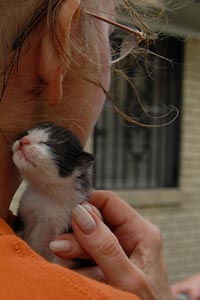
The Best Friends Rapid Response Team provided 3,000 pet carriers when it learned some animals were turned away from buses because they didn’t have their own carriers. The group also assisted at the Jefferson Parish shelter.
The groups provided manpower for the state’s “mega shelter” in Shreveport.”
“Last August, an American Humane Association survey revealed that about 47 percent of pet owners would be reluctant to evacuate without their pets. Many died during Katrina because of this strong animal-human bond.
This time, with Gustav, the empty streets of New Orleans prove that a lot has changed. More people are leaving and more evacuees are taking their pets with them. And those without private transportation no longer have to leave their pets behind. Thanks to new law, policy and practice, the evacuation and treatment of our pets during storms has changed dramatically since Katrina. And that winds up benefiting their owners, too.”
———–
You can also read about dozens of “Storm Orphans” now safe at Best Friends on their website.

We found this in the “L.A. Unleashed” section of the Los Angeles Times. It seems both the House and Senate versions of the “Defense Authorization Bill” contain provisions providing for the government to pay the cost of relocating two pets when a military family is ordered to leave an overseas duty station.
Cats and dogs are certain to be covered, according to the Marine Corps Times. It’s unclear whether birds, fish, reptiles and horses will be eligible.
President Bush, a dog lover, wants the bill on his desk by Oct. 1.
Looking for details about the earthquake in California we found this interesting article in the Desert Sun out of Palm Springs speculating that even though scientists and seismologists can’t predict an earthquake, perhaps animals can. It also provides important tips for the safety of you and your pet in the event of an earthquake.:
Scientists say there’s no way to predict earthquakes like meteorologists forecast the weather, but our furry, four-legged friends may be one step ahead of us.
Shelley Hettig, registered veterinary technician at Desert Dunes Animal Hospital said she firmly believes animals have a ‘sixth sense’ when it comes to predicting earthquakes.
“They’re on the ground in bare feet and they can feel these things. Their senses are so much more alive than ours,†Hettig said Thursday.
Others said their pets were scared by the quake.
“I have a yellow-headed Amazon and when there’s an earthquake he flutters down to the bottom of his cage and acts like he’s being attacked, but he doesn’t know by what,” said Cindy Scott, a vet tech at Animal Emergency Clinic of the Desert.
What are some tips to keep your pets safe in case of an earthquake?
-Make sure there is a supply of canned/dry pet food and bottled water with other emergency supplies including pet prescription and medicine.
-If roads are blocked because of a natural disaster, professional help may not be immediately available so familiarize yourself and other family members with pet CPR, resuscitation and general first aid procedures. Your quick action can save your pet’s life.
-Try not to display stress or anxiety when dealing with pets. Most animals are very aware of their owner’s emotions and can read your stress. This can cause otherwise calm pets to display aggressive behavior.
-After a fire or disaster, check pet structures and favorite hiding places for hazardous debris.
-Ask your local fire department, animal shelter, or veterinarian for a “Pet Alert” sign for doors and windows. In non are available, make your own by listing your pets on a 3 by 5 card and display it prominently. This alerts emergency teams there may be pets that need assistance.
-Dogs and cats should wear I.D. tags with current address and/or phone numbers at all times. This will make it easier for you and your pet to be reunited if separated.
-Keep up-to-date on your pet’s vaccinations. Pets may become disoriented and stray, or housed in shelters with other animals herby potentially becoming exposed to infectious diseases.
-Alert local shelters if your pet is missing.
We are having a seriously hot summer around here so we paid special attention to this list of “Sun Safety Tips for Dogs” in The Honest Kitchen’s newsletter. Apparently it’s from “The Dog Bible, Everything your Dog Wants You To Know” , by Tracie Hotchner:
1. Keep at-risk dogs* completely out of the sun form 10am to 2pm.
2. Put a T-shirt on the dog when outdoors.
3. Provide shade outside over the dog’s area.
4. For indoor sunbathers, pull drapes or block of sunny rooms from 10am to 2pm.
5. Spray children’s sunblock with an SPF of 15 or higher on sensitive areas.
*According to The Dog Bible, some of the breeds most sensitive to sun exposure include:
Australian Shepherd, Beagles, Bulldogs, Chinese Crested, Collies, Dalmatians, Great Danes, Greyhounds (including IG’s), and Whippets.
Tracie lists the following stages and complications of ultrviolet damage:
Reddened skin in thin areas such as the scrotum, belly, inner thigh and nose
Faded skin color
Hair loss
Thick, red scaly blotches
Rough patches
Appearance of “blackheads”
Secondary infection
Blisters with fluid
Formation of scabs
Lesions or depression beneath scabs
Nodules, skin tumors and plaques associated with cancer
Pets in very sunny states such as the southwestern USA are at highest risk of sunburn, as well as those who spend lots of time in the snow, because of reflection of the sun’s ultrviolet rays.
Noses are espcially prone to getting burned and require extra protection when out and about in the sun.
Did you know that dogs are thirty five times more likely than people, to get skin cancer? Please take precautions from harmful rays.
“We Can’t Stay Together for the Dogs,” by author Jennifer Keene, professional dog trainer, was written to help divorcing dog-lovers handle the custody arrangement for their fur kids in a healthy manner.
She also provides helpful information on her website, jenniferkeene.com:
Almost half of the vast number of divorces each year involve dogs, who are more than just “animals” these days. Couples are struggling to do what is right for their beloved dogs, while making one of life’s most difficult decisions. We Can’t Stay Together for the Dogs answers their plight by leading them in choosing dog-friendly solutions and compromises. By integrating training tips and success stories into the text, this self-help guide shows that a dog-friendly divorce or break-up is not only possible, it is the only way to treat our best friends. As the first book on the subject of dogs and divorce or dogs and break-ups it features simple step-by-step directions, and offers a dog-centric point of view that men and women alike will appreciate.
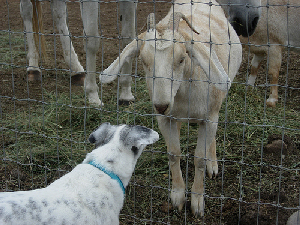
For the long holiday weekend we made a trip to the mountains with a house full of friends to stay at a B&B on Angel Ridge Ranch. We all had a nice time, especially Kylie who had her first face-to-face with a goat!
The ranch is also home to Challenging Spirits Equine Rescue. The owner Denise takes in homeless horses from all over the world and cares for them with the help of volunteers until they find a home. She also rescues horses that are bred for Premarin, a very popular drug used to treat menopausal symptoms in women. Because Premarin is made with estrogen extracted from pregnant mare’s urine (PMU), thousands of mares are used to produce this bitter pill, contributing to the unnecessary overbreeding of horses.
For approximately six months from fall through spring, the pregnant mares live in the “pee barns” forced to stand in stalls with urine collection devices strapped to them. The stalls are deliberately narrow to prevent pregnant mares from turning around and detaching the collection cups. In the last month of their 11th month pregnancy,the mares are put out to pasture to have their foals. The mares are put in a herd with a stallion so they quickly become pregnant again. In the fall their foals are quickly taken away from them to be sold, whether or not they are fully weaned. The next month they are back in the barns, and the cycle starts again.
The manufacturers of PMU drugs would like us to believe that every single foal born as a result of these pregnancies is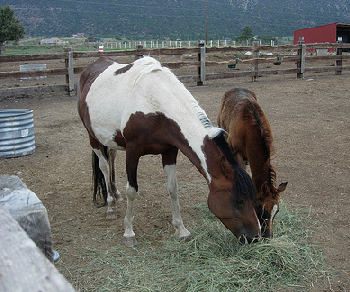 sold to be used for companionship, recreation, ranching, shows and competitions–what they call “productive markets”. In reality, the fillies grow up to replace their worn-out mothers. The colts fates are already sealed. The horse market is over saturated as it is, and there aren’t enough homes for another estimated 5,000 born from this industry every year. As a result, PMU foals are at risk for slaughter, their meat shipped to Europe and Japan for human consumption.
We were amazed at how many horses there were, it’s hard to believe such beautiful creatures could be unwanted. We were also amazed at how much work is involved! If you’re in southwest Colorado and would like to volunteer, please visit challengingspirits.com. Or if you’re unable to physically volunteer, donations are very welcome and very needed, and can be made online.
For the first time ever we have a real house with a real yard which is a real pain! We are having to learn all about things like fertilizer, etc. and trying to make sure it’s all safe for Kylie. So when we saw this headline from the ASPCA’s website it caught our attention and we thought we should pass it along:
PET POISON ALERT: COCOA BEAN MULCH CAN BE TOXIC TO DOGS
If your dog likes to spend his summer grazing in your garden, his treat-seeking nose may lead him to one danger in particular: the sweet-smelling, but potentially harmful cocoa bean mulch. Made of cocoa bean shells and considered desirable for its eventual degradation into organic fertilizer, this gardener’s choice can be toxic to canines if eaten in large quantities—and some dogs have been known to eat amazing amounts!
In 2007, the ASPCA Animal Poison Control Center (APCC) handled 26 cases of cocoa bean mulch ingestion—a third originating in California. “Dogs are attracted to the fertilizer’s sweet smell,†says Dr. Steven Hansen, ASPCA Veterinary Toxicologist and APCC Director, “but like chocolate, cocoa bean mulch can be too much for our canine companions.â€
Ingestion of large amounts of cocoa bean mulch, which contains residual amounts of theobromine—a methylxanthine found in chocolate and known to be toxic to dogs—may cause a variety of clinical signs. These typically start with vomiting, diarrhea and elevated heart rate, and if large amounts are consumed, they may progress to hyperactivity, muscle tremors and possibly other more serious neurological signs.
Treatment includes administering medical-grade activated charcoal, bringing tremors under control, cardiac monitoring and preventing further exposure.
“One key point to remember is that some dogs, particularly those with indiscriminate eating habits, can be attracted to any organic matter,†says Dana Farbman, APCC Senior Manager, Professional Communications. “Therefore, if you have a dog with such eating habits, it’s important that you don’t leave him unsupervised or allow him into areas where such materials are being used.â€
To avoid contact, pet parents should consider a nontoxic alternative, such as shredded pine, cedar or hemlock bark. These will keep your pooch—and your garden—healthy.
This is an amazing animal story.. A Bald Eagle named Beauty got a brand new beak! She was rescued three years ago from slowly starving to death in an Alaskan landfill, after a poacher’s bullet removed her beak, leaving her tongue and sinuses exposed.
She was taken to a rescue and hand fed while her caretakers waited in vain for a new beak to grow, until an engineer volunteered to try and make Beauty an artificial beak.
A gold and titanium pin was glued to the remnant of her upper beak to serve as the guide for sliding the nylon-composite, artificial beak into place. It was a success! Beauty looks beautiful again and more importantly can eat on her own!
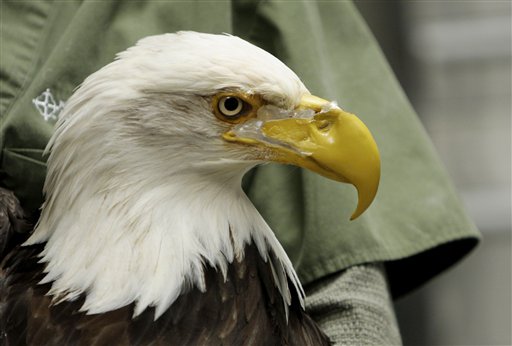
After spending so much time around humans they’ve determined that even with her new beak in place, Beauty does not belong back in the wild. But she will be traveling around the country, participating in lectures to help teach people not to shoot wild birds.
Plans are in place to construct a more permanent version of the beak, The Boeing Co. and a maker of synthetic skin in California have already volunteered for the miraculous task.
Please read the complete story of Beauty the Eagle with an artificial beak on CBSnews.com.
We’re well into disaster season again, fires, and tornadoes have already impacted thousands of families across the nation; and hurricanes are surely soon to follow. Yet a recent article reports that only 40% of families with pets have an evacuation plan that includes their pets. It goes on to report:
The remaining 60% evacuate without their pets and then risk their own lives by returning home prematurely to rescue their animals.
Foresight and planning can protect both pet owners and their four-legged companions.
Julie A. Calligaro, author of “Protect Your Pet With Preparation, How to Keep Your Pet Safe in an Emergency and at Your Disability or Death” offers these steps from her book to protect pets in a fire emergency:
* Include pets in the family’s evacuation plan.
* Rehearse your evacuation plan repeatedly with your family including your dog.
* Have a Pet Safety Kit ready and keep an extra kit in your car.
* Listen to your dog. Canines have the ability to smell smoke long before humans. If your dog is acting strangely, investigate the situation immediately and be prepared to gather your family and pets and follow your evacuation plan.
* Be sure your fire evacuation plan accounts for dogs in pens and crates. Fire experts say the number one reason dogs perish in a fire is because they are confined to their pens and cannot escape.
* Use Pet Rescue Stickers on windows to inform firefighters that you have a pet inside.
* Research pet friendly lodging to have a place to board your pet if necessary.
* Give a key to a trusted neighbor and make sure they know where your pet or pets are likely to be in the house so they can inform firefighters.
* If your pet was in a smoke filled building or if you can smell smoke on his fur take him to a veterinarian. Toxic fumes can be deadly.
For more information about how to protect pets in a weather emergency and at disability or death, visit www.safeguardmydog.com.
———–
We encourage you to please remember to think of your pets and be prepared!
A California company has now successfully cloned puppies (finally). But according to this article from ABC News, you might have to live in the dog house with your cloned puppy to be able to afford it!:
Be sure and click here to watch the video too.
When Mira, husky and border collie mix, was born six months ago, she didn’t just look like her biological mother. She was an exact copy — even down to her personality, according to owner Lou Hawthorne.
A California company has successfully cloned puppies.
That’s because Mira was cloned from her mother, Missy.
“This is just an alternative way of initiating life. And after that, it’s life as we have known it and do know it,” said Hawthorne, CEO of BioArts International, the company that cloned the dog, on “Good Morning America” in a broadcast exclusive.
It is only the second time a dog has been cloned and the first time a U.S. company has done it. BioArts International, which plans to publish its research in scientific journals, sits on the cutting edge of science, in part because it’s opening the door to commercial cloning.
The feat represents a chance for dog owners to keep their best friends around indefinitely in an unconventional way — an interesting proposition for those who view their pets as an integral family member and never want to part with them.
—
For those of you who can’t afford to spend $100K to clone your dog or cat, consider having us immortalize them in a custom portrait in our popular Pop Art style, cool Comic style, or our tasteful Traditional style!

