Archive for the ‘News & Tips’ Category
I don’t know how it happened but we almost let this one slip by us..
Take Your Dog To Work Day
It’s tomorrow, Friday the 22nd! So quick, call the boss! Or better yet, don’t give them the opportunity to say no, just put your furry kid in the car before the morning commute!
Pet Sitters International promotes the event and also use it to bring attention to homeless pets and encourage adoption, here are the details:
If you are looking for the perfect way to celebrate your pooch while positively impacting the lives of homeless dogs everywhere, you definitely want to be a part of Pet Sitters International’s Take Your Dog To Work Day® presented by PEDIGREE JUMBONE.
What is TYDTWDay? It’s simple. On Friday, June 22, 2007, pet sitters, animal shelters and businesses of all sizes will come together to recognize the great companions dogs make.
PSI will join pet lovers around the world to celebrate man’s—and woman’s—best friend. This annual event brings people and pets together in a special way on a special day. Dogs go to work. Hearts are touched. And as a result, homeless dogs will be adopted. PSI’s Take Your Dog To Work Day is the day for dogs and we want YOU and your dog to be a part of it.
They’re also having a “what’s your dog doing at work” photo contest so be sure and take your camera too and snap a picture of Fido doing your filing!!

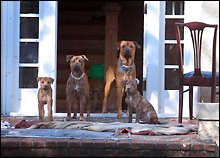 The story about Rita, the Hurricane Katrina refugee who is just now returning to her New Orleans home, is a reminder of the negative impact that Katrina is still having on the animals there. In fact we found this story just this week about the second generation of Katrina’s homeless and abandoned pets:
In New Orleans advocates struggle to deal with animals whose owners can no longer care for them, and with the offspring of cats and dogs lost in the hurricane. Like Hank, a purebred golden retriever, is typical of the second wave of pet problems here in the 21 months since Hurricane Katrina hit.
The first crisis was those pets who were lost, abandoned or killed in the storm and its immediate aftermath.
Now there are pets like Hank, who stayed with his New Orleans East owners for the first 10 months after Katrina, which submerged their home in 7 feet of water. After moving several times and struggling to rebuild their lives, Hank’s owners realized they could no longer cope with owning a dog.
So they surrendered Hank to Animal Rescue New Orleans, or ARNO, a grass-roots group that cares for animals left behind or separated from their owners. ARNO was founded shortly after the storm and survives on donations from volunteers, private sources and other nonprofit groups.
Hank bounded with joy as ARNO shelter coordinator Robin Beaulieu entered his pen recently. Hank flipped onto his back for a tummy rub.
“He loves to be petted and groomed,” Beaulieu said.
The dog has lived at ARNO for the last eight months while he awaits a new home.
Animal advocates say many pet owners living in trailers and tight on cash while they rebuild flood-damaged homes opt to give up their animals because they don’t have space or can no longer afford to keep them.
“So many people out there need help with their pets,” said Charlotte Bass Lilly, ARNO’s executive director.
Beaulieu estimated that the number of families surrendering their pets to shelters had gone up between 45 percent and 60 percent since Katrina. Laura K. Maloney, executive director of the Louisiana Society for the Prevention of Cruelty to Animals, said some of the animals up for adoption by her agency could be the offspring of animals separated from their families since the storm, but many were pets relinquished by their owners.
According to LA/SPCA statistics, about 259,400 families owned pets in Orleans Parish before the storm. As many as 104,000 pets were left behind after Katrina; about 15,000 were officially rescued. An estimated 3,000 have been reunited with their families, and at least 88,700 remain unaccounted for, Maloney said. Thousands of the pets unaccounted for are believed to have died.
ARNO and other animal-advocacy groups believe that many strays on the streets are “Katrina pets” and their fourth- or fifth-generation offspring. And many have not been spayed or neutered.
Bass Lilly said that unscientific counts by ARNO volunteers who manage the group’s 3,000 feeding stations throughout Orleans, Plaquemines and St. Bernard parishes estimate that as many as 40,000 cats and 5,000 dogs are on the streets.
“There are still dogs out there with collars,” Bass Lilly said. 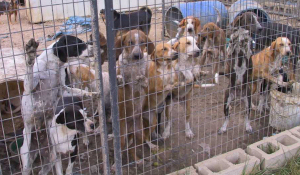
Although stray or abandoned animals were not unique to New Orleans, “what makes it different is that these animals are homeless, with no food, water and no garbage to forage. They’re basically in a stress situation.”
University of Pennsylvania researchers surveyed six areas of Orleans and St. Bernard parishes on behalf of the LA/SPCA six months after the storm and found that “relatively few” homeless animals remained.
Maloney said that feeding stations were not “in the best interest” of stray animals and made it more challenging to capture them.
“We are taking animals that are left there, and we are sustaining them,” she added. “That really doesn’t solve our problem. We are helping create more homeless kittens and puppies, and we need to stop.”
ARNO’s food sites cover a 685-square-mile radius, Beaulieu said. Volunteer trappers capture the animals for sterilization. Feral cats are trapped, neutered and released.
Bass Lilly said that over the last nine months, her group had found new homes for about 200 animals a month. And since Katrina, the volunteers had helped reunite between 50 and 70 pets with their original owners, Bass Lilly said.
Reunifications are still crucial almost two years after the storm.
“Every day, animals show up,” said Laura Bergerol, a volunteer with a grass-roots online group called the Katrina Animal Reunion Team.
The animals are featured in newspaper ads, on Web sites advertising missing pets, and even on Craig’s List, said Bergerol, who is based in Palo Alto.
There are about 200 animals living at ARNO’s shelter, housed in a warehouse in Jefferson Parish. Bass Lilly said the group had a “no kill” policy.
One day last week, a cacophony of barks blended with the occasional purr as Beaulieu showed volunteer Ray Forrester how to trap five kittens he spotted in his neighborhood.
“You line the cage with newspaper and put food on it,” Beaulieu said. “The best thing to use is sardines. And Popeye’s fried chicken works wonders.”
Cats typically are trapped in cages, dogs often with a noose. It can take several months to win an animal’s confidence so that it is willingly captured.
With the population of New Orleans down to half its size, and thousands of people across Louisiana living in cramped trailers, there are fewer local takers for Katrina pets. So the group is working with partners nationwide to find new homes for the animals.
“Katrina animal celebrity is a way to make people feel they are directly helping with Katrina,” Beaulieu said.
Source: LA Times
A black Labrador Retriever, rescued during Hurricane Katrina, is scheduled to fly back from here in Denver where she has been fostered, to her home in New Orleans this week.
The Lakewood, Colorado based Misha (Mutts in Safe Homes Always) May Foundation rescued Tasha, as she was known then, from a New Orleans shelter in October 2005. Sunni Rodgers and Brendan Landry took the dog into their home 18 months ago and decided to adopt her eight months later. They called her Rita. Three months ago, Lorraine May, the executive director of the Misha May Foundation, called Rodgers and Landry to tell them Rita’s original owners wanted the dog back. Rodgers says the news came as a shock.
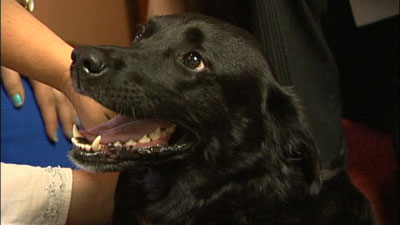 “We waited probably eight months before we even adopted her thinking eight months – that’s a long time,” she said. Rodgers says she has talked on the phone to Sandra, Rita’s owner. “I wanted to talk about what was best for the animal because she’s pretty much been here all her life. Was it best for her to go back or stay here? And they wanted her back, definitely,” Rodgers said.
Rita had a pre-flight checkup Monday at the Colfax East Animal Hospital in Denver.
“I think there’s two good things that came out of this,” Landry said. “One, that Sandra gets her dog back, which is a good thing for her, and that because of people like Lorraine, being dog lovers that we are, is hopefully having another opportunity to rescue and provide another good home for another dog.”
“We’ll definitely miss Rita. She’s grown in our hearts. She’s our little girl, so she’ll definitely be missed here,” Rodgers said.
Source: 9news.com
On a side note to this bittersweet story, we found out about the Misha May Foundation just last month and they’re really a wonderful group. We even donated a portrait, coincidentally of a Black Lab, for a silent auction at their annual fund raiser. You can learn more about the great work they do on their website.
Having trouble controlling your dog on the walk? Here are a few pointers on how you can … Master the Walk:
1) Give yourself time. If you can, allow a full hour for the activity. At the very least, I recommend setting aside 30 minutes. 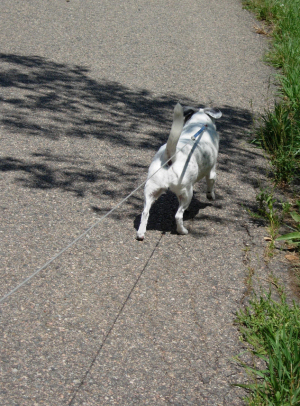
2) Walk during the day. Dogs are diurnal animals, just like humans. This is what is most natural for both species.
3) Wait until the mind is calm. Don’t even put the leash on until your dog is in a calm-submissive state.
4) Leave first. Don’t let your dog dart out when the door opens. Again, wait until your dog is in a calm-submissive state. Then you can exit, followed by your dog.
5) Lead. Make sure your dog is behind you or next to you during the walk. He should never be out in front.
6) Use a short leash. This will allow you to have more control over the walk. Need more help? Check out the Illusion collar.
7) Let your dog explore. After your dog has maintained the proper state of mind, you can reward him by allowing him to relieve himself. After this time, he may also sniff around.
8) Pick up after your dog. Be a responsible dog guardian. Don’t leave the poop for others to scoop!
9) Walk in first. When you get home, be sure to enter your territory before your dog.
10) Have a plan. Don’t stop leading after the walk. Let your dog know what is expected of him. Is there a place you would like your dog to sit and wait while you put away his leash?
11) Share food and water. It’s reward time! After the walk is the best time to feed your pup. Some dogs may prefer rest before eating, but all dogs can benefit from access to water. By ending the walk with a meal, you have helped to give your dog the natural experience of having “worked” for food and water.
Source: Yahoo
Every year we like to check out this list and see if we need to move for Kylie’s sake, but since we’re only 45 minutes from the current #1 city I guess we can stay put for now. We thought we should share it with you so you can see where your city ranks:
Nearly 74 million dogs are living with their owners in this country. But it’s where they live that may just give them a leg up on their canine colleagues. Men’s Health has released their ranking of the Top 50 cities for dogs. From the number of dog parks, to the number of vets and pet stores in the area — all of these and more were considered when picking the best locations.
5. Seattle, WA
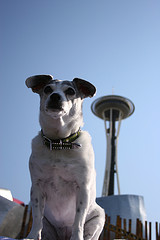
Seattle veterinarians report one of the lowest numbers of heartworm cases in dogs, a parasitic infection transmitted through mosquitoes. Either the mosquito population is low (surprising, as 40 percent of the city is water), or dog owners are just as proactive about heartworm prevention as they are about pushing for more dog parks. In 1995, Citizens for Off-Leash Areas (COLA) was formed to push for a piece of the city’s nearly 400 parks. Today, there are almost a dozen dog parks in the city, with more in the surrounding suburbs.
4. Tucson, AZ
Dog don’t get nine lives, but one should be enough in Tucson, where there are more veterinary practices accredited by the American Animal Hospital Association than in any other city in our rankings. Keep your hound well-hydrated and you’ll not only avoid a visit to the vet, but you’ll also be able to enjoy the perpetually sunny skies. For those without a dog (or who want to give their current canine a companion), the city’s local Channel 12 TV station shows a program called “Pet Connection” that tries to make lifelong matches between owners and animals.
3. Albuquerque, NM
Even though the largest animal gathering in the city (a.k.a. the Rio Grande Zoo) doesn’t allow dogs, it does provide kennel services for visitors, a small touch that highlights the pervasive atmosphere of affection for dogs. Another clue: Everywhere you go, someone’s holding a leash — New Mexico has the second highest dog ownership rates. This passion for pooches even extends to the Mayor’s office. For the past four years, the city has sponsored the Mayor’s Dog Ball, a charity event that supports efforts to education children about the humane treatment of animals.
2. Portland, OR
Portland has plenty of parks for humans, including one of the largest in the U.S. (Forest Park, with over 4,000 acres), but dogs aren’t left out in the cold: The city boasts the most dog parks per resident. When throwing a stick gets old, dog owners have their pick of the litter when it comes to finding a new toy at one of the many pet supply stores in the area. And while your hound might want to do the doggie paddle in one of the city’s many famous fountains, tell him to heel — even when he sees the group entitled “Animals in Pools.â€
1. Colorado Springs, CO
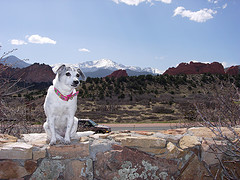
With about 250 days of pure sunshine a year and an abundance of outdoor activities, the entire city is practically a playground for pooches. (If you’re really adventurous, you can even try “skijoring” a sport/activity that involves getting on cross-country skis and having a large, energetic dog pull you dogsled style.) Colorado Springs also earns top marks for its number of boarding and doggie daycare facilities, and it levies the highest maximum fine for animal cruelty — $500,000.
Source: MSNBC
Obviously dogs have their own language, and they learn the words you teach them like “sit,” “wait,” etc.; but something we have noticed living with Kylie is that she knows lots of words we never taught her (at least not on purpose). For example, once during a casual conversation about actor/comedian Tom Green, we noticed Kylie was getting very excited about what we were saying. We were perplexed and asked her, “Do you like Tom Green?” and she went nuts! We were starting to think that we better stop leaving the tv on for Kylie while she’s home alone, when we figured out that she thought we were talking about her then favorite treats, “greenies”. We never taught her the word “greenie” she just knew what they were and assumed that “Green” was short for greenie – pretty smart! She associated the sound of the word with the object that she knew, even when it was completely out of context. This is how dogs often learn the name of their favorite toy or activity, you don’t have to teach them – they just get it.
So we found this article on Yahoo about how dogs learn the english language, and even body language on their own, very interesting and wanted to share part of it with you.:
As acute as a dog’s hearing is, we ought to give them a little more credit for understanding our language. We know we can teach our dogs verbal commands, but many dogs learn to understand words we haven’t purposely taught them. We may find ourselves saying, “Let’s go for a walk†as we pick up the leash. The dog first associates the leash with the promise of going for a walk. He may also pick up on the word “walk†without his owner making a move toward the door or picking up the leash.
Astute owners who notice their dog’s linguistic talent have tried to develop it further by teaching words rather than commands. Some dogs are able to find their ball when the owner says, “Where’s your ball?†Some dogs appear to have an extensive vocabulary and can follow detailed directions like, “go to my desk and bring me my pen.†While this ability astounds dog owners, and anyone watching, scientists have tested dogs who show such prowess, and the findings are less or more impressive, depending upon how you look at it.
Dogs can learn many words, without a doubt, especially names of objects or commands. But to follow more complex directions, dogs rely on other skills. According to Stanley Coren in How to Speak Dog, a dog will listen to your words, and watch your subtle, even subconscious body language, and then add his most reasonable guess to figure out what you want him to do.
In the above command, for example, the dog may know what a pen is because his owner taught him that word-object association. The person giving the direction made a subconscious glance in the direction of the desk, which told the dog which way to go. Most dogs are masters at reading body language. The dog goes to the desk and sees the pen. The most reasonable and obvious thing for a good, well-trained dog to do with an object, is to retrieve it. This creates a very convincing illusion that the dog understood English well enough to follow a complex command.
In How to Speak Dog, to test the theory that dogs rely more on our body language than words, a dog was told to go to one place, but the person speaking glanced in a different direction. The dog always went to where the person was looking.
Dogs may never have a complete command of our spoken language, but their ability and interest in listening to our words and observing our body language in order to do what we ask of them, to ultimately please us, is really truly impressive.
———————————————–
If they think that’s impressive they should meet Kylie, because she even knows how to spell! We realized years ago that it did no good to say “c-o-o-k-i-e,” she knew exactly what we were talking about. She also knows what “K-y-l-i-e” spells, and will respond just like you said her name, and we never used flashcards or anything!
We recently made the acquaintance of Claudine Hellmuth, a very creative artist with a very unique craft, collage art! It’s very cool, yet very hard to explain, but we love finding exciting new forms of custom art and sharing them with you.
 The way it works is, you send Claudine some pictures of you and your friends or your family and tell her your story and give her ideas about how you envision your artwork. You can also specify color and even send fabric, wallpaper or paint swatches to include and Claudine will match her paints to colors you prefer.
It’s fabulous and Claudine has been featured on HGTV and has even published books and instructional DVD’s sharing her techniques for creating “Hip Art for Playful Hearts!”
Please visit her website to see her gallery of work, learn more about the process, and how you can have your own collage art – they make amazing gifts, by the way!
The best thing about meeting Claudine for us was finding out that she is also an animal lover and learning about her friend, Bernie.
Bernie Berlin operates A Place to Bark, an amazing no kill foster and adoption rescue which focuses on abandoned and abused animals that are classified as “hard to place,” due to their special needs or behavioral problems.
A Place to Bark is currently in desperate need because next week, Bernie is going to drive 60 little lives to Chicago and Wisconsin to be adopted — these are little puppies and kittens who were on death row and would not be alive had Bernie not pulled them from animal control. These 60 fur babies will be adopted out at no-kill humane societies, when she does this, all the puppies and kittens find homes within 3 days of her taking them there!
But Bernie needs our help. The cost to run the transports will be around $1500. The air conditioned cargo van to rent costs $600, gas is $240 to Wisconsin and back and $180 to Chicago, she goes through approx 40lbs of Dog food A DAY and the transports take about 2 days each min. Then 20lbs of cat food a day + medical certificates and shots for all the animals. You can imagine how it adds up. She gets no monetary help from the humane societies and relies on outside donations alone.
We have put the banner on the right on our blog to help facilitate donations to Bernie, please give if you can and please tell your animal loving friends too.
You can read more about A Place To Bark on their website and on Bernie’s blog.
This is amazing! It was on national news today – soon you can take your mixed breed dog to the vet for a simple blood test and find out exactly what breeds make up your mutt. It’s a doggie DNA test!
Here’s the story from ABC News:
Although purebreds compete in front of judges for best in show at the Westminster dog show, it’s every day mutts that compete for the affection of millions of Americans. Now, thanks to a new doggie DNA test — the wisdom panel from Mars Veterinary — curious mutt owners can finally trace their dogs’ roots.
“This is where high tech meets high touch. You’re going to take a small blood sample from this dog and take its unique DNA and be able to determine what the breed makeup is and it’s ancestry,” Dr. Marty Becker told “Good Morning America Weekend Edition.” “So you will know its grandparents, its parents and know exactly what kind of dogs are in this makeup of this mixed breed.”
Becky and Alex Shelton wanted to learn more about the background of their family pet Sol, a 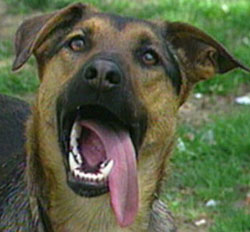 stray they rescued from their neighborhood. “When you look at him, I just want to know what he is so bad, just to know when people ask me, what kind of dog is that? I can actually tell them that’s what he is,” Becky said.
At a compact 45 pounds with short legs, a long body and long floppy ears, the Sheltons believe that Sol is part German Shepherd and part Jack Russell Terrier, with a personality to match. “You can’t not like him. He’s so hyper, but he’s got the sweet little face,” Shelton said. “And he just sits with you and wants to be loved.” Becker tested Sol for the Sheltons.
Beyond simply satisfying curious dog owners, DNA testing also serves an important medical purpose. “Once you know what the breed makeup is, there are certain diseases that are more prevalent in those breeds, so you’ll be able to be on the look out for those diseases and actually take steps to prevent them,” Becker said.
Once the results were back, Alex and Becky Shelton finally learn their lovable stray’s origins. Sol is a mix of a Dachshund, German Shepherd and Norfolk Terrier.
————————
You can learn more about the test that will be available to vets in about a month on WhatsMyDog.com, the official website for the test, called the “Wisdom Panel” by Mars Veterinary. You can even print a letter to take to your vet so they can find out about offering the test to their clients. We’re taking one to Kylie’s vet asap!
We have made some updates around here recently to help keep Pop Art Pet new and interesting. First as we mentioned a few posts back, we have greatly expand our Photo Tips section. We have suggestions to help you submit an ideal photo for your personal Pop Art Pet portrait whether you’re scanning a photo, or if like many of our clients, you’re pet is no longer with us and you have a limited selection of pictures. Or if you have the advantage of a digital camera, we have provided tips that will help you whether you’re a technically savvy shutter bug or you don’t know a megapixel from a megabyte. We also show you some good & bad examples, like the ones below to help you out with the do’s & don’ts.
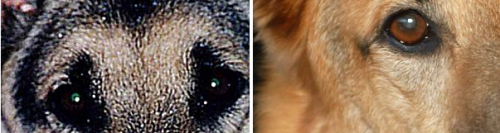
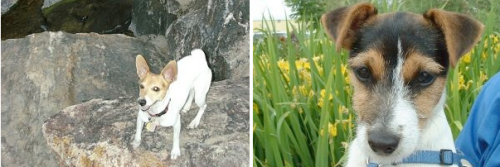
We provide all this information because we want to deliver the best possible portrait of your pet, one that you will adore for a lifetime, and to do that we must start with the best possible photo.
Speaking of creating custom pet portraits that our clients adore, we have also updated our Testimonials page. We have had the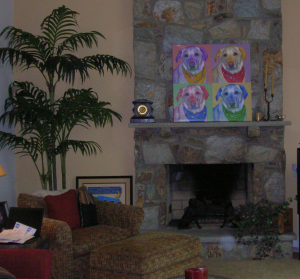 honor of immortalizing your pets for six years now and thought it was time to share some of the more recent responses our artwork has elicited. We’ve even included some photos of the finished pieces on the wall in their home – which we always love to see.
It’s always great to hear how profoundly our portraits sometimes affect people who truly love their pets – after all, that’s why we do what we do! And hopefully sharing these sincere, unsolicited, comments on our site will instill confidence in our future clients and let them know that we really care about capturing their pet’s personality on our custom canvas portraits.
Menu Foods announced yesterday that it was recalling even more of the pet foods produced in its plants. This recall expansion covers dozens of new brands and foods — wet foods only — citing cross-contamination as the concern. This announcement comes more than a month and a half after the initial recall.
Also the FDA has finally raised the number of reported pet deaths attributed to the tainted foods from 16 to more than FOUR THOUSAND. By some estimates even this number may only be 10% of the actual number of pets who have died, when you consider those who died before the contamination was reported and those who did not receive veterinary care and were presumed to have died of natural causes.
Again we urge you to keep up to date on the recalls, and we refer you to Itchmo.com for the most current and detailed information.


