Archive for the ‘News & Tips’ Category
When the weather was hot we provided some tips and advice on how to keep your pets cool and comfortable and safe. Well, now the seasons have certainly changed and the cold can be just as dangerous for dogs as the heat, especially for senior dogs. Here are some easy ways to keep your old friend cozy and comfortable this winter.
Healthy dogs with longer coats are able to maintain their body temperature during colder weather; but certain breeds, such as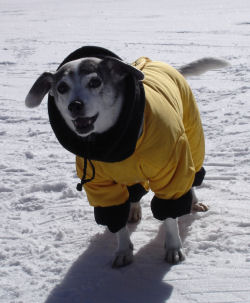 Greyhounds, Labs, and other short-haired breeds may need some extra help. Dogs with thinner coats and lower body fat content benefit from wearing a coat. Even with a warm sweater or jacket, however you should restrict your dog’s outdoor exercise during extremely cold weather (15 degrees fahrenheit or lower).
When there’s a lot of snow on the ground, be sure and clear a potty area for your dog, and provide older pets, especially those with arthritis, a warm sleeping area indoors away from drafts to prevent aching, stiff joints.
Make sure to check your dog’s paws after outdoor romps in cold weather and remove any salt, ice, or snow. You should also keep the hair around their paws trimmed to prevent snow and debris from sticking, because it can be very uncomfortable and cause more serious problems with their pads if ignored. Some vets recommend using dense, wax-based creams on dogs’ paw pads to prevent cracking and irritation from ice and ice-melting chemicals.
Cold weather can make certain medical conditions in older pets worse, such as hypothyroidism, a disorder in which the thyroid gland secretes insufficient amounts of hormones. If your dog gains weight during the winter (without a change in diet), is always seeking warmth, seems sluggish, or has an unhealthy coat, you may want to consult your vet about having his or her thyroid levels checked.
If you are attentive to your pet’s special needs during the winter and keep them warm, dry, and loved; you can all enjoy a winter wonderland this season!
We have made our dates and deadlines available for this Holiday Season so you won’t miss your opportunity to give the gift of a Pop Art Pet portrait to the pet-obsessed person on your shopping list:
The last day to order a portrait with stretching services and guarantee delivery by Christmas Eve is Friday, November 24th. However, and this is crucial, we must have a suitable photo to work with by this date! After this date, if you are requesting to have your portrait stretched and need delivery by Christmas Eve, you must pay a Rush Fee.
After December 6th, stretching services will not be available for any Holiday orders, and a Rush Fee, as well as expedited shipping rates will be required to ensure delivery of your rolled portrait by Christmas Eve. December 10th is most likely our last day to accept any Christmas orders, but please contact us – if we are able to evaluate your photos, we may determine that we can complete your order!
If you miss our deadline (or would rather not pay a rush fee), you can contact us prior to placing an order and we will let you know if we can have proofs ready for you by Christmas. This would allow you to make some sort of presentation to the recipient on Christmas then deliver a belated, but still wonderful, gift to them after the Holiday.
If you would like to give the gift of Pop Art Pet but you know you cannot have a photo for us to work with in time for the holidays, remember we do offer Gift Certificates. Gift Certificates are available in any dollar amount you select, or for any specific size and style that you choose. Gift Certificates can be sent in time for Christmas via snail mail if ordered by December 16th, or we can send them electronically, for you to print it, if ordered by 5:00 p.m. (central) on the 23rd. They make an awesome gift and they allow the recipient to have creative freedom in selecting their favorite photo to be used for their portrait!
Get more details on our Holiday Order page.
According to the American Veterinary Dental Society, 80 percent of dogs already show signs of oral disease by age 3. Oral (periodontal) disease is caused by a buildup of plaque, which contains a large amount of bacteria. Left unchecked, plaque buildup on a dog’s teeth can cause more than just a case of bad breath. Without treatment, this condition can ultimately destroy the tissue and bone structure that support the teeth, and can lead to other health issues. The most effective way to combat this irreversible condition and keep a dog’s teeth pearly white is with daily brushing or chewing, and routine checkups with a veterinarian.
 Chew products, such as bones, rawhides and compressed vegetable treats, can play an important role in a dog’s dental care. “Chews are an easy choice for pet parents who want to improve their dog’s oral hygiene — or who just want to freshen their pet’s breath,” explains PetSmart Pet Expert, Dr. Robyn Jaynes, DVM, noting that chew products can effectively reduce tartar and plaque. And, while playing an important role in a pet’s dental care, chew products also satisfy a pet’s natural inclination to chew.
But beware, says Jaynes. One size chew product does not fit all dogs. “If the chew is too small or too soft, it can be dangerous, like any small object in the home,” she explains. “On the other hand, it probably wouldn’t be too much fun or beneficial for a miniature poodle to drag a 10-pound bone around all day.”
Along with regular brushing, chew products can be a safe part of a dental care regimen at home when pet parents are equipped with some basic knowledge, including how to select the right size and material for their dog:
— Not all products are appropriate for all dogs. Just as there are different types of toys appropriate for different dogs, there are also different types of chews for different types of dogs.
— Chews should be size-appropriate and match the dog’s chewing style. For example, a large dog that has a tendency to chew and swallow large pieces should only be offered a large bone with medium density that is digestible. Likewise, a small dog or puppy should be offered size- appropriate chews that are of a softer material.
— Pet parents should observe how their dog chews regardless of the type or brand of chew or toy, especially when offered a new chew for the first time. If a dog is able to chew off and swallow large pieces, the chew is not appropriate for that dog.
— Pets should be monitored consistently when chewing any product, and pet parents should watch for any sign of choking, gagging or coughing both while the pet is chewing and after the chew has been swallowed. A dog showing these or similar signs should be taken to a veterinarian immediately.
In addition to practicing a regular dental care regimen at home for their pet, pet parents should schedule regular dental checkups for their pet with their veterinarian. Jaynes notes, “Your vet is a great resource for questions about dental health, the benefits of chew products, and how to select appropriate chews for your pet’s needs.”
Source: PetSmart.com pressroom
This is an amazing rescue story from Wisconsin last week. A disabled woman’s specially trained companion dog, Jesse, saved her life then tragically died trying to rescue the cat as well. The complete, heroic story is from the AP on Yahoo:
Jamie Hanson said her 13-year-old dog Jesse brought her artificial leg and a phone she used to call 911. “She got me outside and then she heard the cat upstairs and she went up there to get the cat and she wouldn’t come back to me,” Hanson, 49, said at a news conference Monday at Aurora Sheboygan Memorial Medical Center, where she was being treated for her injuries.
She received third-degree arm burns in the fire Sunday night at her home in Rhine, south of Elkhart Lake. Both pets died.
Hanson, who lost a leg in a car accident three years ago, said she was on the couch watching television when the cat ran over the back of the couch. “And he jumped onto a table that had a candle on it and tipped it over and lighted the artificial plants on fire,” she said.
Hanson said she fell off the couch and was unable to get her artificial leg from the table, “so my dog got my leg for me and went and got the phone and brought the phone to me so I could call 911.”
This story shows the amazing capacity dogs have for devotion to their families. Jesse was truly a hero.
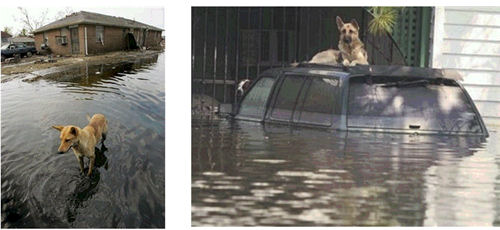
Hurricane Katrina left thousands of pets displaced, and of those who were rescued only a very small percentage were ever reunited with their families.
This is why the Digital Guardian Angel Pet ID System, and pets-911.com was developed, to help you as a pet guardian be able to recover your pet should they become separated from you for any reason. It is really a brilliant system that utilizes but does not require the latest technology. There are three components to the Digital Guardian Angel System that attach to the pet’s collar:
The Stainless Steel Two-Sided Pet Tag, is a pretty standard identification tag which provides the owner’s contact number as well as the pets-911.com website and the pet’s individual registration number that the rescuer can enter on the website to get more information about the pet and how to contact his or her family. Finally the tag alerts the person who found the pet that there is digital data attached to the collar in the pet wallet.
The Digital USB Flash Drive stored on the collar can be plugged into any computer, whether it runs on Windows or MAC, that has a USB drive. It contains data formatted as both an HTML file and a PDF file to make it virtually universal, that includes pet owner’s multiple points of contact whether by telephone or email addresses, or alternate responsible parties, pet medical history, food, skin and drug allergies and symptoms, lifestyle and behavior findings and pet photos along with the pet owner’s photos for proof of ownership. This way you would not have to worry about your pet being adopted out or euthanized. FYI – the company performs stress-tests on the Flash Drive by tossing it into a six foot chlorinated pool for 20 minutes, driving over it by a two-ton vehicle and twisting it with a pair of pliers. Even with all that abuse, the drive continued to work faithfully. They even offer a 10-year manufacturer’s warranty to ensure long life.
Finally, the Pet Collar Wallet prevents the flash drive cap from coming off while the pet is active. It is both rugged for active use, and weather resistant made from neoprene which is the same material found in scuba diving wetsuits. Being flexible, the wallet easily slides over small to large pet collars and fits almost like a glove. It is very difficult to rip or tear making it an excellent choice for pet use, rain or shine year round.
The creators of the Digital Guardian Angel pet recovery have made this system as inexpensive as possible to maintain, so that you can afford to list and tag all of your pets – for their sake and your peace of mind.
The founder of pets-911.com, Michael Rogers, writes on their website, “Think of how many shelters and vet offices are equipped to scan a microchip or read tattoos. Now try to think how many more potential computers and laptops there are just in your local area? Those numbers are the odds that are stacked in both you and your pet’s favor. That’s a comforting thought!”
Research in the emerging field of animal perception reveals that what we see, hear and smell isn’t necessarily the same as what our pets do. For example, humans have more color receptors than dogs, so we can see better close up and in the dark than they can; while cats can see clearly in conditions six times darker than we can.
The human nose is like an old static-filled, black-and-white TV compared to a dog’s high-definition, state-of-the-art set. If you laid out all our smell receptors (about 5 million), they would fill your average postage stamp. A dog’s receptors (about 220 million) would cover an average handkerchief. Canines are even becoming medical diagnosticians. Researchers at the Pine Street Foundation, a cancer research organization in California, have trained dogs to detect cancer on a patient’s breath. They found that the dogs detected lung cancer with 97% accuracy and breast cancer with 88% accuracy. Maybe some day, you’ll get a dog scan instead of a CAT scan!
Both cats and dogs can hear things you cannot, which is one reason most dogs make such terrific home alarm systems. Cats can hear sounds several times higher than we can, which is useful when they hunt.
All this suggests that the inexplicable behaviors we may observe in our pets shouldn’t be dismissed as simply nutty. The world they live in is different from ours—but we are growing closer and learning from each other every day.
[Read the entire article on Parade.com to compare more of your pets’ perception to yours.]
The Humane Society of the United States celebrated the news that President George W. Bush – who said during Hurricane Katrina that if he had to evacuate the one thing he would take would be his dog Barney – has signed the Pets Evacuation and Transportation Standards (PETS) Act on October 6, 2006. The act helps ensure that America’s pets and service animals aren’t left behind in the next disaster.
The bill – which was introduced in the House by Rep. Tom Lantos (D-Calif.) and Rep. Chris Shays (R-Conn.), Co-Chairs of the Congressional Friends of Animals Caucus, and in the Senate by Sen. Ted Stevens (R-Alaska) and Sen. Frank Lautenberg (D-N.J.) – requires the inclusion of companion animals in disaster planning at the state and local levels. It was approved by unanimous voice vote in the U.S. Senate on August 4 and the U.S. House of Representatives on September 20.
“We’re tremendously grateful to the House and Senate leaders who reacted swiftly by introducing the legislation, and shepherded it through the committee process and floor votes to today’s signing by the President,” said Wayne Pacelle, president and CEO of The Humane Society of the United States. “While Katrina wreaked so much devastation and disruption, it also highlighted the remarkable bond between this nation and our pets and service animals, and the need for public policy to echo that appreciation of animals.”
The final bill that the President signed contains provisions to help with disaster planning, including:
-requiring that local and state emergency preparedness authorities include plans for pets and service animals in their disaster plans to qualify for grants from FEMA;
-granting FEMA the authority to assist states and local communities in developing disaster plans to accommodate people with pets and service animals;
-authorizing federal funds to help create pet-friendly emergency shelter facilities; and
-allowing FEMA to provide assistance for individuals with pets and service animals, and the animals themselves, following a major disaster.
“People victimized by disasters should not suffer needless additional injury by having to abandon their household pets or service animals to their fate,” said Rep. Tom Lantos. “With the cooperation of state and local authorities under the mandates of this new law, nobody will ever again have to confront the choice between personal safety and that of their animal companions.”
“During Hurricane Katrina, tens of thousands of animals became homeless or perished. Many pet owners stayed with their pets and perished,” added Rep. Chris Shays. “Today, we ensured that won’t happen again. Communities across the nation are now required to include pet owners and their pets in emergency evacuation plans. I am grateful for the advocacy of The Humane Society of the United States and the bipartisan, bicameral support of this measure.”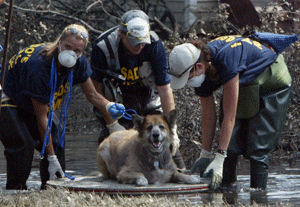
HSUS disaster experts note that evacuations will run more smoothly if pets are included in pre-disaster planning. “People lost their lives in the wake of Katrina because government responders told them their animals had to be left behind and they couldn’t bear to abandon their pets,” said Pacelle. “For many people who face losing everything, their pet is the only comfort they have left.”
There are over 358 million pets in the United States residing in 63 percent of American households. A recent Zogby International poll found that 61 percent of pet owners say they would refuse to evacuate if they could not take their pets with them.
“We learned many important lessons from Hurricanes Katrina, Rita, and Wilma. One of these lessons was that we must put procedures in place to evacuate not only residents in areas impacted by a natural disaster, but also pets and service animals,” said Sen. Ted Stevens. “This legislation is an important step forward in our efforts to mitigate personal suffering during times of disaster.”
Source: HappyNews.com
 A unique animal shelter in Encinitas, California is helping abused women by helping care for their pets. The shelter works in conjunction with women’s shelters to provide abuse victims with a safe place for their beloved animals. It’s something most of us don’t even think about, but there is a big need for this kind of program across the country. Domestic abuse shelters will not take your pets, which makes it that much harder for women in abusive relationships to leave; they are already dealing with so much trauma and loss, the thought of leaving their pet behind too is unbearable.
When someone is in an abusive relationship, every family member suffers, including the pets, who often become pawns in the relationship, used to exert power and control. The abusive party can use the animal to keep that person in the relationship, and may even abuse the pets. At the Rancho Coastal Humane Society, they’ve seen the impact this can have on pets. They’ve housed more than 400 pets in their Animal Safe House Program, while women get themselves back on their feet.
Recent statistics show close to 40 percent of battered women believe they have no options. Many are so concerned about staying with their pets, they put off finding help. This program offers victims a chance to get out of a bad relationship and save their animals, and takes in 50-60 pets a year. The animals of domestic violence victims can stay at the shelter for up to three months at no cost, as long as that victim is staying in a shelter.
While Halloween is a fun time for families and kids, it can be stressful or even dangerous for your pets, so keep your animals off the lawn and in the house for Halloween. For outdoor cats, especially black cats, keep them inside for several days before and after Halloween. If left alone, your pets could be injured, stolen, or even killed by pranksters.
Also, keep your animals away from harmful items. Chocolate is poisonous to many animals, and candy wrappers can be hazardous if swallowed. Pets should be kept away from lit pumpkins as well, for they may start a fire or harm themselves.
Costumes can also be harmful if you put them on your pets. Make sure the costume is not annoying or unsafe to them. It should not constrict its movement, hearing, or ability to breath or bark. And make sure there’s nothing on it that your pet could chew off and choke on.
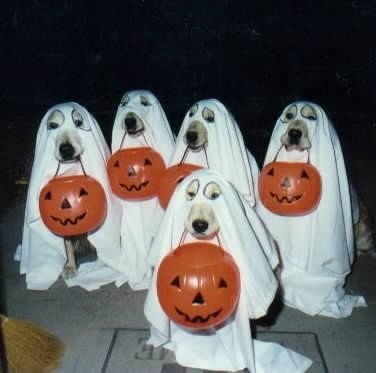
When trick-or-treaters start to come by, keep your pet in a separate room. If you keep the pets around the kids, they may become scared or run out the door.
And as always, please make sure they’re wearing identification in case the pets become lost.
Keep those sugarless treats out of Fido’s reach. Veterinarians warned on Friday that a commonly used sweetener might cause liver failure in dogs, and perhaps even kill them.
Their report in the Journal of the American Veterinary Medical Association appears to strengthen the suspected link between the sugar substitute xylitol, thought to make dogs sick, and possible liver failure.
Xylitol, a naturally occurring product, is found in many sugar-free chewing gums, candies, baked goods and toothpastes.
Researchers Sharon Gwaltney-Brant and Eric Dunayer with staff at a poison unit of the American Society for the Prevention of Cruelty to Animals in Urbana, Illinois, gathered information on eight dogs treated between 2003 and 2005 after eating products containing xylitol.
Each dog became ill, and five died or had to be put down because of liver failure, possibly from ingesting xylitol.
One dog who had to be euthanized had eaten four large, chocolate-frosted muffins containing about 1 pound (0.45 kg) of xylitol.
“People don’t think sugar-free gum can kill their dog. I didn’t before I got into this. But this is something people should be aware of,” Gwaltney-Brant, who co-authored the study with Dunayer, said in a statement.
Gwaltney-Brant said for dogs, ingesting even a small amount of xylitol can trigger significant insulin release, which drops their blood sugar and can be fatal.
“A 22-pound (10-kg) dog who consumes one gram (0.03 ounces) of xylitol should be treated,” she said, adding that further studies were needed to definitely establish a cause-and-effect relationship.

